
The Interior Question
Late last year I encountered Colin King through the Last Layer his newsletter on Substack. A friend working in the design industry had mentioned him in passing and the internet quickly served up his feed. The first post I read was What We Get Instead. I had expected confident advice for a design-obsessed world (there’s that) but what I discovered was a finger pointing in the same direction– to what lies behind a room.

photo credit: Colin King from his Substack The Last Layer
It makes perfect sense. Another profession that spends a lot of time cornered in rooms, thinking about rooms, is the designer, decorator or stylist. Most designers would not describe their work as a consciousness raising endeavor and most, I imagine, are not as lucid about the psychological dynamics at play in a room as Colin King. Still their workday world entails grappling with what’s in the room, the raw materials, in a way that reminds me of a psychoanalyst’s task.
A scroll through post headings on the Last Layer reads like an index of psychological topics. There is wanting, regret, belief, fear, perfectionism, resolution, reassurance, art and even a quote from Winnicott. This overlap between design and psychology intrigues me. Are we dealing with opposite sides of the coin: physical objects on one side, psychological stuff on the other? It seems design questions can flip to psychological questions pretty easily. Why did you put that there? Do you stack or display? Why so colorful? Why so muted? Let’s face it, no matter our line of work, we are all in the business of arranging life. And if we aim for a little more consciousness, sooner or later we have to deal with the interior.
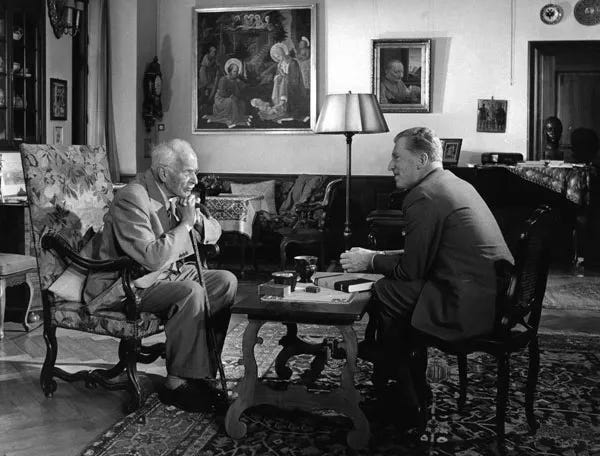
photo credit: a corner of C.G. Jung’s dining room from the film C.G. Jung Speaking
Meet a Jungian and you might eventually hear them say, “As without, so within.” What the alchemists believed still holds. Interiors and exteriors mirror each other. The extraordinarily clean kitchen gives anyone a snapshot of the psyche in charge. It might also beg the question: Where is your junk drawer? Outer and inner worlds belong to each other and the unconscious as Jung was keen to point out from the early years of his theorizing, is always compensating– in ways subtle and grand. Any room, I venture, represents more than a resolution of style, comfort and cost.
Rooms have something to mirror back to us even when they are not those of our own devising. Our reactions can key self-understanding.
I wonder if Colin King ever thinks about the room as a force field, a spirit, or a psychological projection screen. He certainly gives it subjectivity: “A good room notices.” He notes that rooms should have a friction that leads to participation. They should make us think as well as enjoy ourselves.
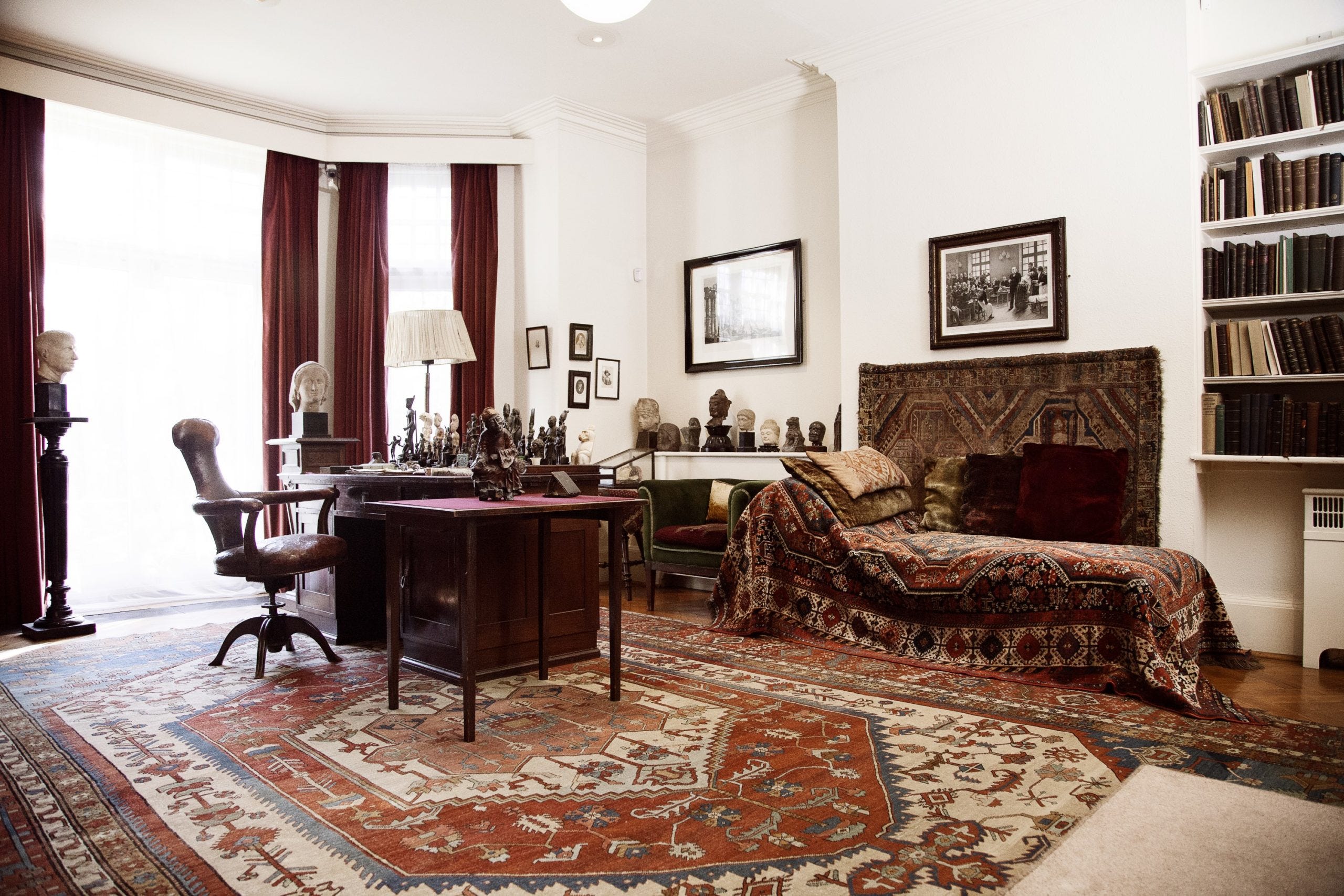
photo credit: Sigmund Freud’s consulting room, The Freud Museum, London.
Get curious about the room that spikes your attention because it feels so cozy or off-kilter. Maybe that’s where you need to spend an hour. No telling what you might discover on or off the couch.
Next week– back to the enfilade.
Love "enfilade"...stealing.
I said to myself, "oh, of course"! Sigh. Smile. As a lover of "fashion", which of course runs along similar lines, how perfect to see "interior design" explored, and in such pellucid prose. (I know pellucid is a bit stuffy but it so describes this intriguing, fun essay.) Thanks!