
Intermittent Light
by Sal Nudo
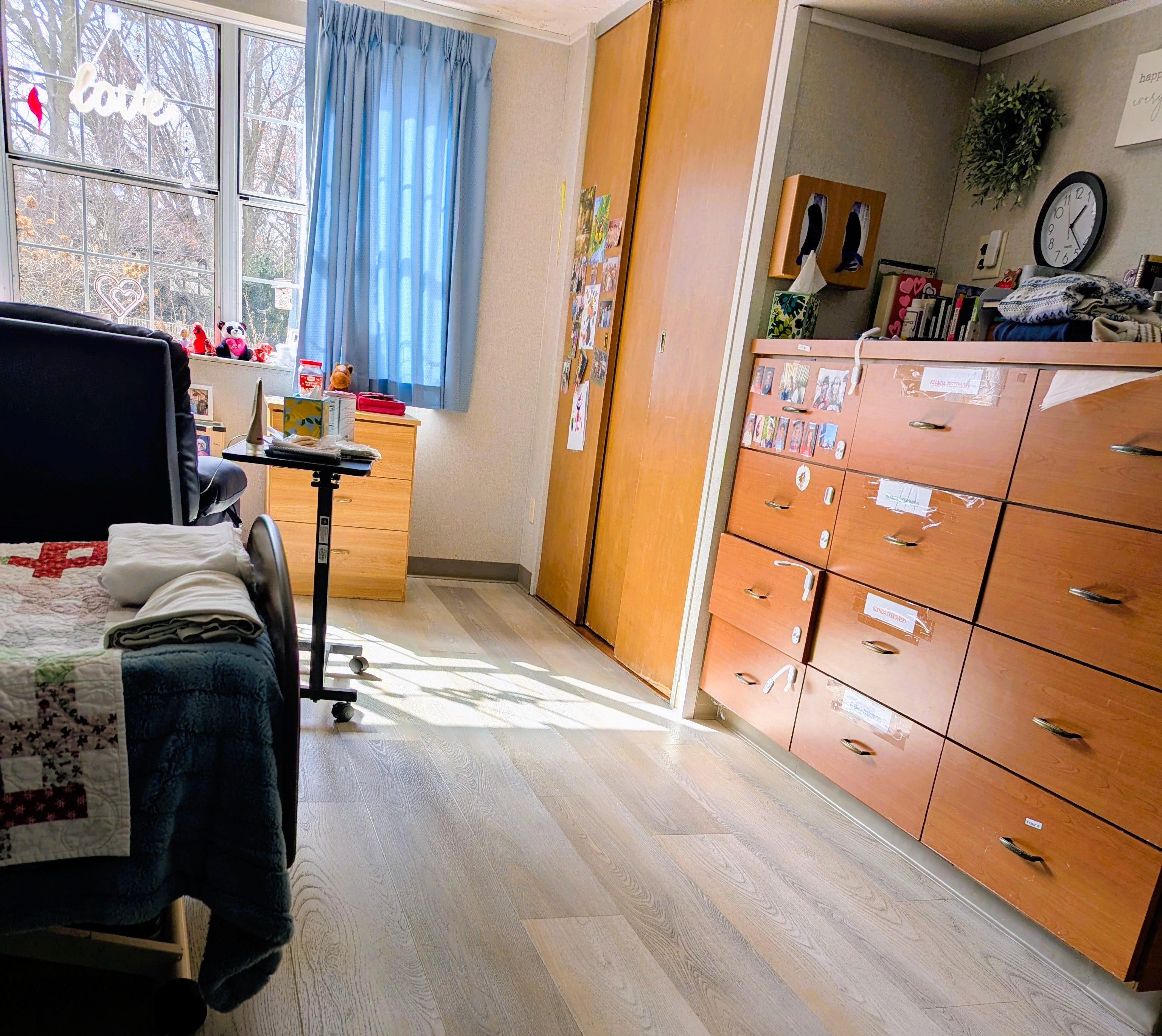
The long dresser with three rows of drawers could pass for a piece of furniture in a college dorm room. On the top right are three bottles, two of them haircare products. A black boom box sits nearby with a pink brush in front of it. Further left on the long shelf are a pair of socks, folded sweaters, more brushes, and several books against the wall. One of the books is The Scarlet Letter. Another one, which looks like a book but isn’t, says “Birthday # 90.” A white-haired lady takes center stage on the cover with a pink crown on her head.
I’m not in a college dorm.
A sink is lodged between the dresser and a wall and I take a photo of it with my phone. I look at the image and see a partial reflection of myself in the mirror above the sink, holding my phone with the flap of its protective brown cover open. My eyes are looking downward and my face is somber. It looks like I’m reading a small book.
Mom sleeps soundly in her corner of the room, near the door, like usual. She’s wrapped in a light purple blanket and has an intense look on her face, as if snoozing is arduous. Mom has light brown splotches on her cheeks and forehead and her white hair is swept backward touching her shoulders.
It’s a bitterly cold, windy, cloudy day in the Midwest with the sun peeking out intermittently. When it does, the light shines through the paneled window of the room, hitting the floor, offering signs of life opposite of where I sit. Neither of my mom’s roommates are here.
I ease onto Mom’s bed, careful not to sit on her legs. Just as I place my phone on top of my peacoat, a young woman, who might be a CNA, walks in.
“Oh, sorry,” she says, though I’m glad for her presence. “I’m trying to find somebody who needed help and I don’t know where they went.” Her voice is folksy, friendly. The woman vanishes from the room as quickly as she came in.
There are two clocks ticking in the room. One of them, just above the long dresser in the room’s center, ticks slower than the clock near the window. People walk by in the hallway outside Mom’s room, employees of the memory-care facility and visitors like me.
A man and woman across the hall are visiting someone and I hear periodic questions about the whereabouts of family members and how people are doing. The elderly resident asks about the man’s aunt and he tells her she is deceased.
Outside, two birdhouses attached to a pole—one of them shaped like a house, the other a cardinal—sway in the wind. The scenery beyond the window is pleasant with a scramble of large leafless trees, smaller trees with brown bulbs, and a thicket of stems with similar brown bulbs. Behind all this, a big Tudor-style house, with a beige fence protecting it, rounds out the setting. Spring will arrive in a month to enliven the view.
Mom moves with a jerk on her side. Is she waking?
“Mom, can you hear me?” I ask right away. “It’s Sal. Are you okay?”
I try again.
“Hi Mom! Are you cold? Okay, Mom. It’s okay.”
I tell her I’m her son and again that it’s okay. I tell her I love her.
Five minutes later she stirs some more, but this time her movements are more urgent. She has a grimace on her face and starts to shake and moan. When Mom gets like this, it looks like she’s suffering through a nightmare or some disagreeable remembrance. But I know the anguish is from whatever medication they have her on.
Whereas the middle of the room has a college dorm-like appearance, the side by the window, where one of Mom’s roommates lives, is childlike. Stuffed animals and heart-laden knickknacks spill across the windowsill in vibrant hues of red, pink, and white. The word “love,” shown in lowercase and in cursive, hangs from a cord at the top of the window. To the right, taped to a sliding closet door, are several photos of family members and children’s drawings.
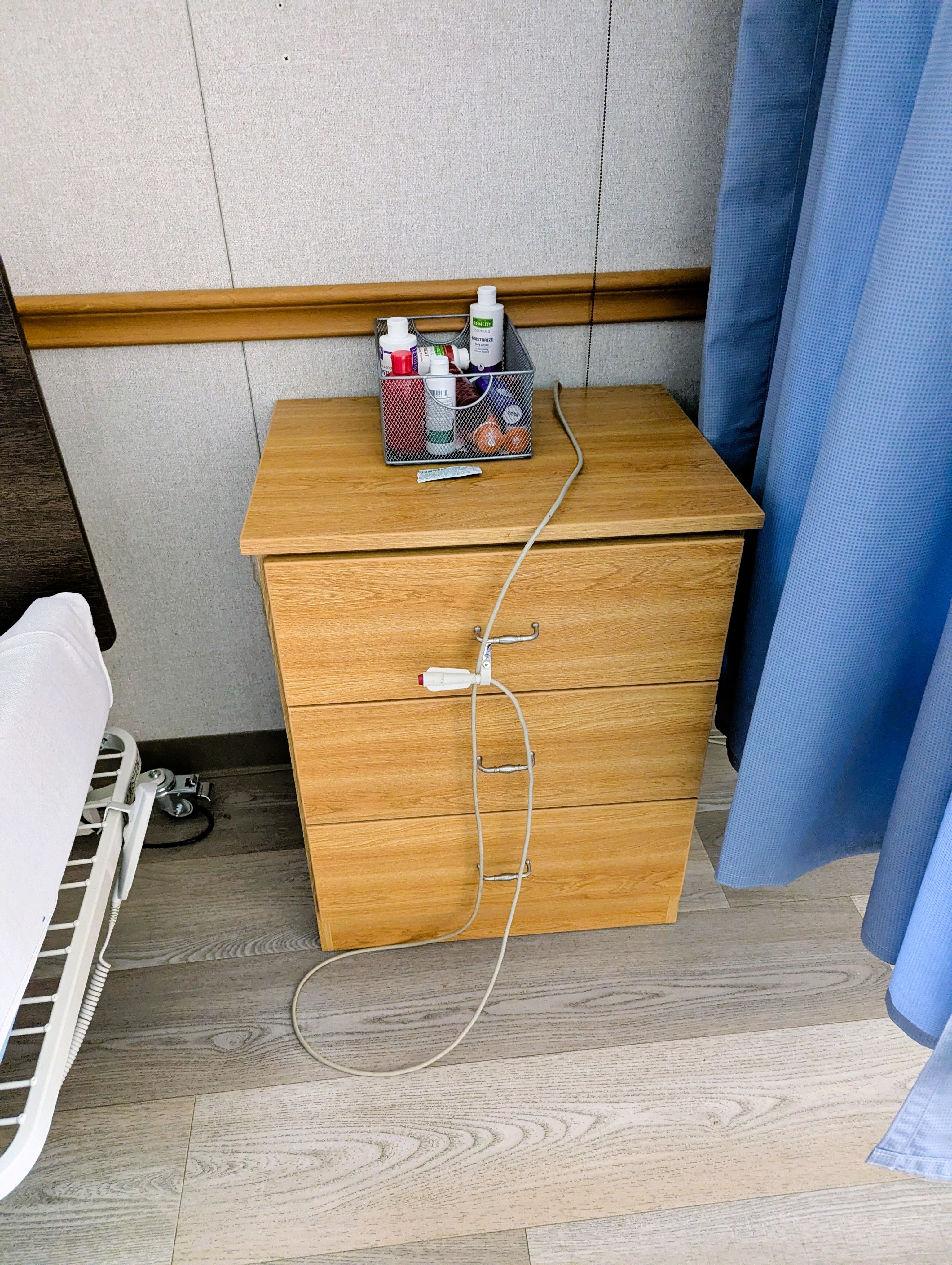
The room’s center is less playful but also has perky elements. A rustic-style, impressionistic painting of flowers in silver vases hangs above a bed. Either real or fake flowers are stationed atop the bedstand on the right. On the left is a hardcover copy of Black Hawk Down. The lady who resides in this part of the room is perpetually “reading” this book and telling me how good it is. Her demeanor is so friendly and relatively coherent that at times I wonder if she belongs here.
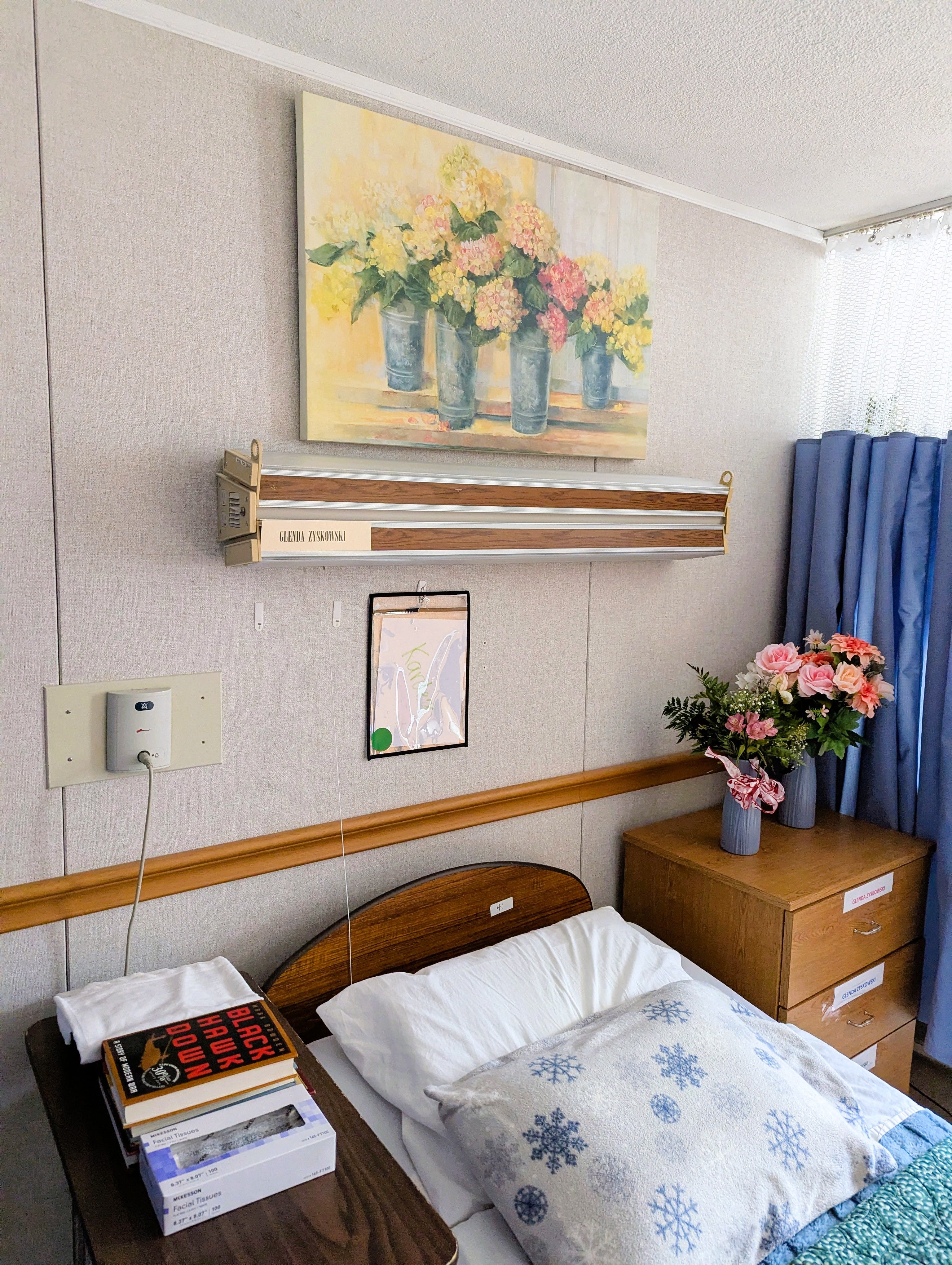
Mom’s side of the room is plain with a simple three-drawer dresser near the partition curtains and a metal case that holds items such as antifungal powder, moisturizer, and deodorant.
Sporadic beeps of varying volumes and urgency outside of Mom’s room get my attention from time to time but nothing urgent is happening in our domain. A woman walking by in the hallway says to the man she is with, “She can’t hear.” The man agrees with her wholeheartedly.
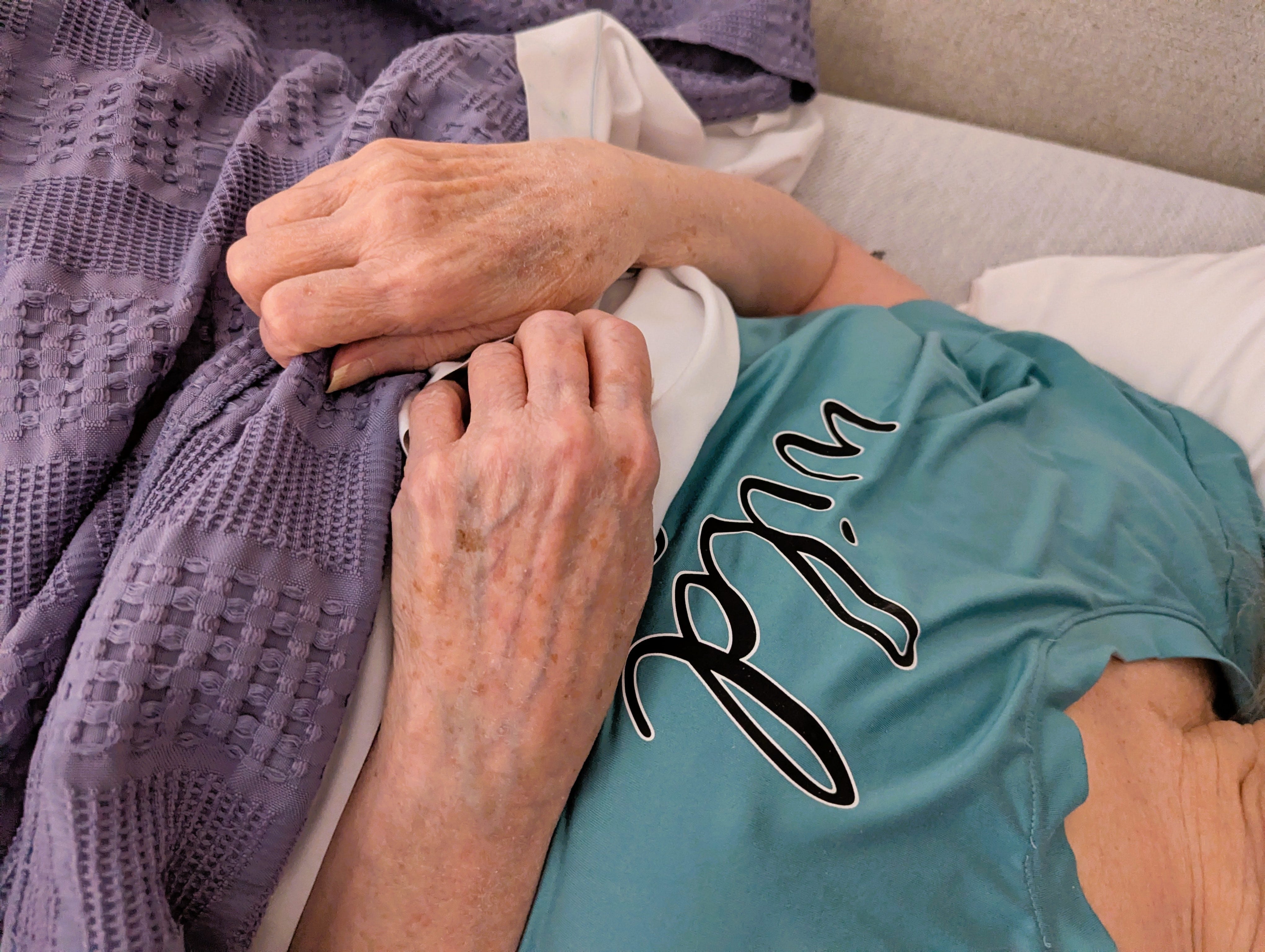
Mom passes gas, surprising me. Maybe it’s time to go. I’m even more astonished when her eyes fly open and she begins laughing and mumbling. I tell Mom who I am, saying I’m glad she opened her eyes. She laughs more, leading to light coughs. The top of her satiny shirt reads “Wild,” but I can’t see what it says after that. I try to lower the blanket she is grasping to see the rest of the words, but she doesn’t like that. I leave the blanket be.
I stay with Mom for a minute or two longer before kissing her on the cheek, telling her goodbye, and watching her as she closes her eyes.
Sal Nudo was recognized by Townsend Press in 2025 as a “What I Believe” Essay Award winner and was a third-place recipient of the 2015 Marian and Barney Brody Creative Feature Article Writing Award in Journalism from the College of Media at Illinois.